
Is there such a thing as a ‘free’ DSE assessment?
With office furniture providers offering ‘free’ DSE assessments, we explore some of the challenges behind this apparent money-saver for businesses, from issues of quality and rigour, to the potential for costly upselling and overspecification. When it comes to DSE assessments, don’t you get what you pay for?

What is a DSE assessment?
How you sit at your desk might seem like a minor issue, but bad posture, prolonged sitting, inappropriate furniture, lack of space, and inadequate training can all impact physical health, which in turn can impact mental health and productivity.
Under The Health and Safety (Display Screen Equipment) Regulations, employers are legally required to carry out Display Screen Equipment (DSE) assessments for knowledge workers to protect them from the health risks of working with display screen equipment such as PCs, laptops, tablets, and smartphones.
The legislation is in place to protect these workers from musculoskeletal pain and injury which can develop over time. Left unmanaged, the resulting damage can progress from mild to severe conditions and lead to longer-term health problems. That’s not only bad news for the employee but for their employer too, with a reduction in productivity and more sickness absence as a result.
A free service?
The need to carry out DSE assessments is obvious – but how to go about it is less clear-cut. Not all DSE assessments are created equal, and whilst there are ‘free’ services being offered, are they as good a deal as they first appear?
With more individuals, especially homeworkers, struggling with their workplace setup, some office furniture suppliers and ‘ergo’ dealers are offering free DSE assessments as an incentive to use their services. However, we would argue that by opting for these, you might end up paying down the line, in more ways than one.
The degree of expertise behind these offers can be questionable – and an unsophisticated tick-box approach could fail to identify needs appropriately.
There is also the risk that the provider’s approach could be skewed towards their own sales objectives rather than the worker’s best interests. With the potential for upselling or over-specification of certain products rather than generic recommendations, ultimately it will be the client that pays – even if they’re getting a ‘free’ service upfront.

The Osmond Ergonomics way
At Osmond Ergonomics we make no bones about the fact that we do apply a charge for our assessments because we know the level of expertise, service, and support provided is sufficiently valuable to warrant it.
In doing so, we can keep assessments independent of our sales provision, ensuring all our recommendations are entirely outcome-focussed and based solely on the solutions which serve our clients and their employees’ needs best.
A good DSE assessment will provide a systematic review of the user’s needs, equipment, furniture and environment, identifying not only the issues but providing the solutions, and crucially the training, to ensure they are effectively resolved.
For bulk DSE assessments that meet statutory compliance requirements, we normally recommend an online process using a purpose-built software tool, such as Healthy Working from our partners at Cardinus Risk Management.
However, there will always be some personnel for whom a face-to-face assessment by a qualified contractor is the optimal solution. Typically, this will be when people are experiencing musculoskeletal pain and discomfort. In such circumstances, we think it’s essential to integrate user training and education into the process.
Our virtual DSE assessments comprise a 30-60 minute video call with a qualified advanced assessor and include a comprehensive DSE report containing case background, issues identified, training provided and reasonable adjustments recommended.
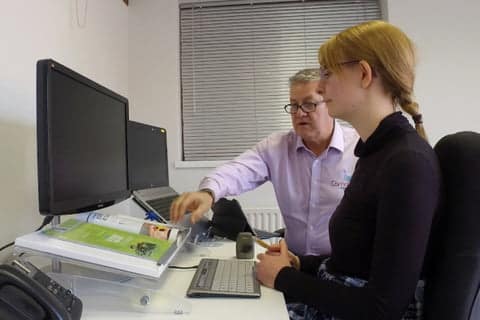
A physical face-to-face approach is nearly always the best solution. We do these onsite DSE assessments for both office and home workers. The process is similar to the virtual service but has the added benefit of providing much more context, in-person training, immediate help with the existing setup and, as a result, a more holistic solution.
Ultimately when it comes to DSE assessments, you get what you pay for. With something as important as the health and wellbeing of staff on the line, does it make sense to cut corners? Be careful that those apparent up-front savings don’t see you landed with a larger outlay down the line as a result of overspecified recommendations.